Quick Answer
Factor | Email Marketing | Marketing Automation |
Channels covered | Email only | Email, SMS, website, social, ads |
Tracking depth | Opens, clicks | Full behavior: page visits, form fills, cart abandonment |
Personalization | Basic (name, segment) | Dynamic, behavior-triggered |
Setup complexity | Low – live in a day | Moderate to high – needs workflow mapping |
Typical cost | Free–$50/month | $300–$3,000+/month |
Best for | Solopreneurs, early-stage startups | B2B, SaaS, ecommerce with longer funnels |
2026 AI capability | Basic subject-line/send-time AI | Predictive lead scoring, AI journey optimization |
Email marketing is a single-channel tool for sending campaigns to a list; marketing automation is a full system that tracks behavior across your website, email, and other channels to trigger personalized actions automatically. Choose email marketing if you’re under ~500 contacts with a simple sales process. Choose marketing automation once you need to track behavior across multiple touchpoints or personalize at scale. Most growing businesses eventually use both – email marketing is a feature inside marketing automation, not a replacement for it.
Marketing Automation vs Email Marketing: 2026 Guide
Why This Comparison Still Confuses Marketers in 2026
Most people ask “which one is better” when the real question is “which one matches where my business actually is right now.” Buying marketing automation software before you have a repeatable email process is like buying a CRM before you have customers – the tool doesn’t fix a process gap, it just makes the gap more expensive.
Here’s the practical distinction: email marketing is a channel tool. Marketing automation is a system that happens to use email as one of its channels. You don’t graduate from one to the other because one is “better” – you graduate when your customer journey gets complex enough that a single channel can’t capture it anymore.
What Is Email Marketing?
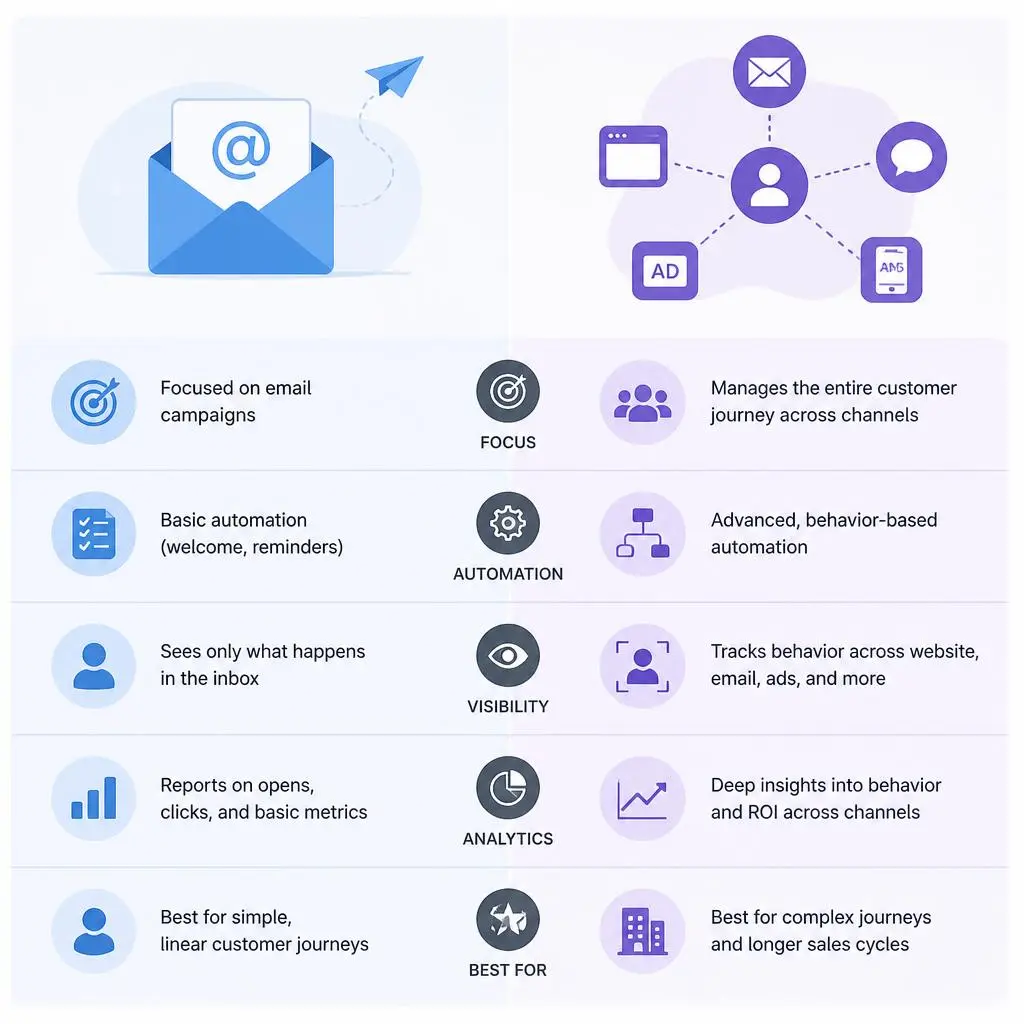
Email marketing is software built to send, design, and measure email campaigns to a list of subscribers. It typically includes templates, list segmentation, basic automation (welcome sequences, abandoned cart reminders), and open/click analytics.
It remains one of the highest-ROI channels in marketing precisely because it’s cheap to run and doesn’t need a complex setup. The tradeoff is scope – it only sees what happens inside the inbox. It has no visibility into what a subscriber does on your website, whether they viewed your pricing page twice, or if they abandoned a demo request.
Who Email Marketing Is Best For
Solopreneurs, early-stage startups, and small businesses with a simple, mostly linear sales process. If your typical customer journey is “sees content → signs up → buys,” you don’t need behavior-tracking complexity – you need consistent, well-written emails that go out on schedule. Growing that list organically starts before the inbox, though – most of your subscribers will come from content that ranks, which is where a solid On-Page vs Technical SEO: The Ultimate Guide for 2026 approach pays off before you ever open an email tool.
What Is Marketing Automation?
Marketing automation is a system that tracks customer behavior across multiple touchpoints – your website, email, ads, and sometimes SMS or chat – and triggers automated, personalized responses based on what each person actually does, not just who they are.
Instead of “send this email to everyone on Tuesday,” automation logic looks like: “if this visitor viewed the pricing page twice and didn’t book a demo, send a case study email 24 hours later; if they open it, alert sales.” That’s a fundamentally different capability than email marketing offers.
Accurate behavior tracking depends on something people rarely mention in these comparisons: your website has to actually load fast and fire tracking events reliably. A slow, unmaintained site drops tracking pixels, breaks form submissions, and quietly corrupts the data your automation platform depends on – which is why teams running serious automation pair it with ongoing monthly website maintenance packages rather than treating the website as a “set and forget” asset.
Who Marketing Automation Is Best For
B2B companies, SaaS businesses, and any brand with a sales cycle longer than a single email. If your customers interact with you across multiple channels before buying – content, email, a demo, a follow-up call – automation is what stitches that journey together instead of leaving it to guesswork.
Email Marketing vs Marketing Automation: 6 Key Differences
Scope of Channels
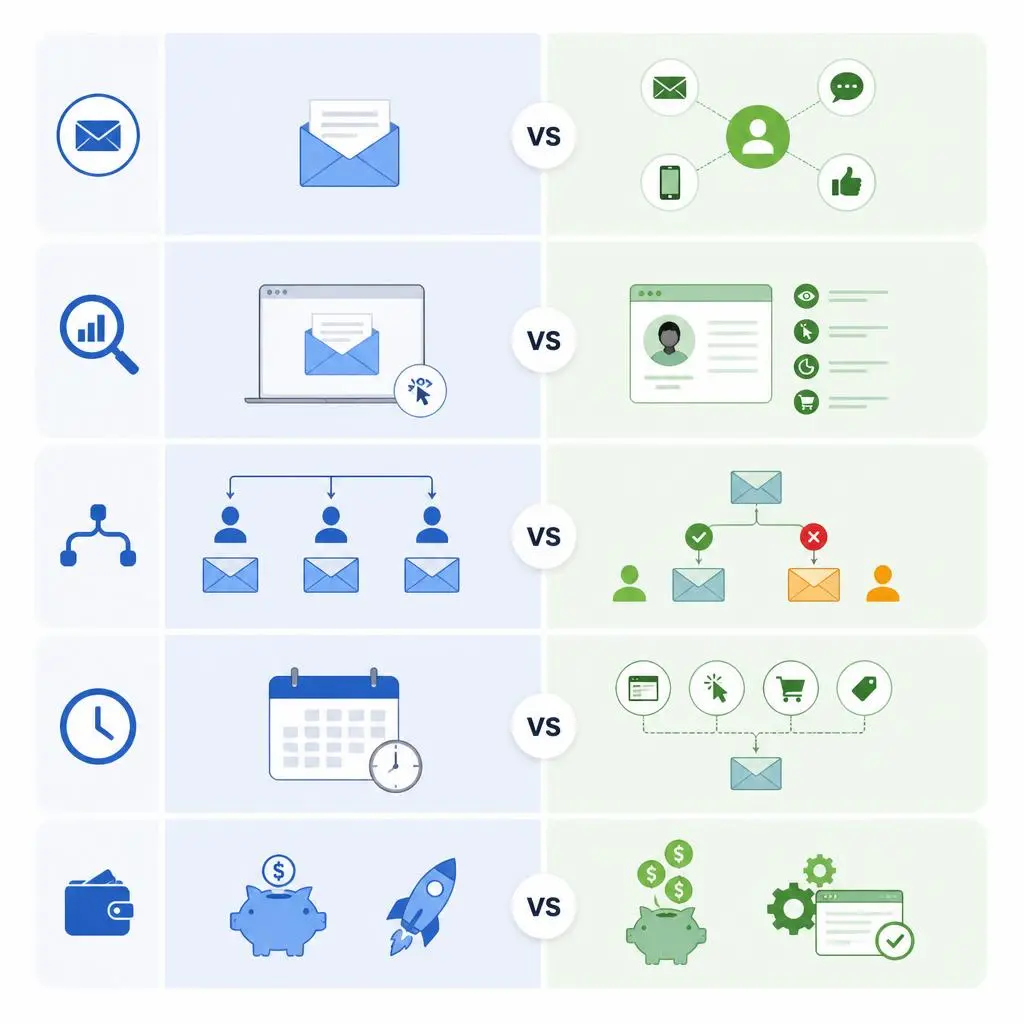
Email marketing = email only. Marketing automation = email plus website behavior, SMS, ads, and often social – one dashboard tracking the full journey instead of one slice of it.
Data & Lead Tracking
Email tools track opens and clicks. Automation platforms track page visits, time on site, form abandonment, and repeat behavior – building a profile that updates in real time, not just a mailing list.
Campaign Complexity
Email marketing sends the same follow-up to everyone regardless of behavior. Automation branches: two people who get the same first email can end up on completely different paths based on what they actually do next.
Level of Automation
Email automation is mostly time-based (send this 3 days after signup). Marketing automation is behavior-based (send this because they did X) – a meaningfully different trigger logic.
Price & Setup Time
Email marketing tools are cheap and live same-day. Marketing automation platforms cost more and take real setup time – workflow mapping, integration with your CRM and website, and testing before they run reliably.
AI & Predictive Capability in 2026
This is the gap most 2024-era comparisons miss entirely. Modern email tools now offer AI subject-line testing and send-time optimization – useful, but still reactive. Marketing automation platforms in 2026 increasingly ship with predictive lead scoring (flagging which leads are statistically likely to convert before a human even looks) and AI-driven journey optimization that adjusts the sequence itself based on aggregate performance, not just individual triggers. If AI-assisted prioritization matters to your sales team, this is where the platforms genuinely diverge.
Where They Overlap
Both use email as a core channel, both aim to increase engagement and conversions, and both pay for themselves quickly when set up correctly – email marketing through low cost, automation through recovered revenue from leads that would otherwise go cold. Neither replaces good content; both amplify it.
How to Decide: A 4-Point Checklist
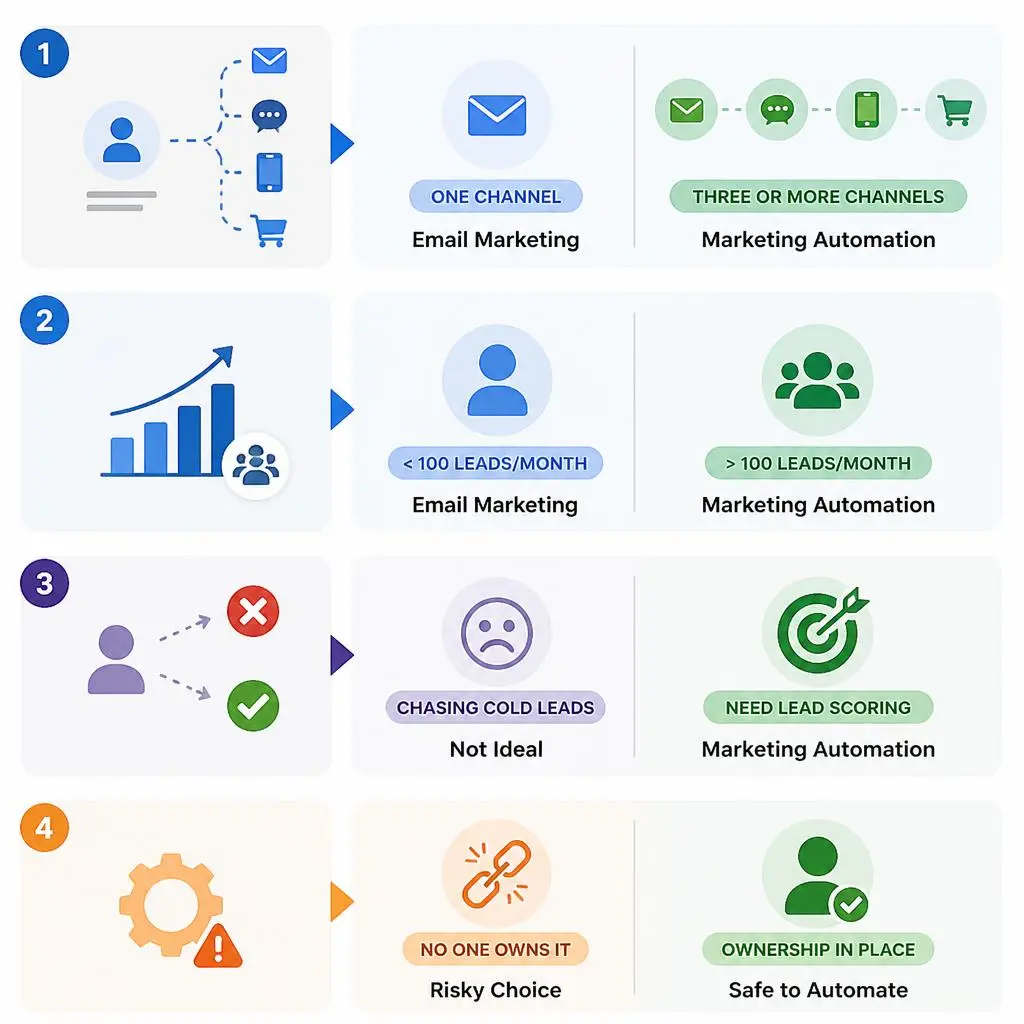
- How many channels does your customer actually use before buying? One (email) → email marketing. Three or more → automation.
- What’s your monthly lead volume? Under ~100 new leads/month, automation’s tracking depth is often wasted. Past a few hundred, manual segmentation in an email tool becomes unmanageable.
- Does your sales team need lead scoring? If sales complains about chasing cold leads, that’s an automation signal, not an email signal.
- Can you maintain the setup? Automation workflows break silently if nobody owns them. Don’t buy the tool before you have someone who’ll actually build and maintain the logic.
Real-World Use Cases by Business Stage
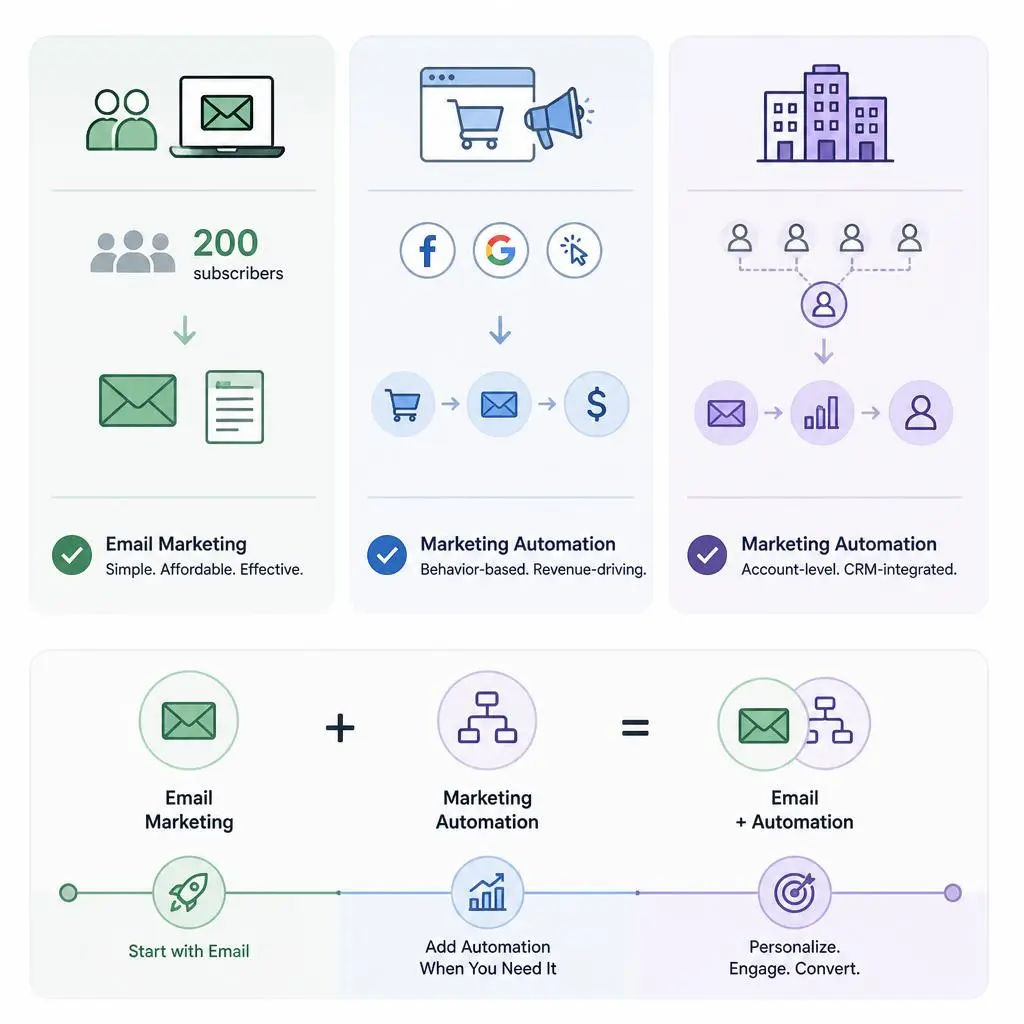
Early-Stage Startup
A two-person SaaS startup with 200 email subscribers doesn’t need lead scoring – they need a clean welcome sequence and a monthly newsletter that keeps the list warm. Email marketing wins here on cost and simplicity, full stop.
Growing SaaS/Ecommerce Brand
Once you’re running paid ads, have a website generating steady traffic, and see customers interacting across multiple pages before converting, automation starts paying for itself – cart abandonment flows alone often cover the platform cost within the first month for ecommerce brands.
Enterprise with Complex Sales Cycles
Long B2B sales cycles with multiple stakeholders need automation tied directly into the CRM – tracking which stakeholder opened what, scoring accounts (not just individuals), and handing qualified leads to sales automatically. Email alone can’t structurally support that.
The Hybrid Approach: You Don’t Have to Choose Just One
Here’s what most comparisons frame as binary but isn’t: nearly every serious marketing automation platform includes email marketing functionality. You’re rarely choosing one over the other – you’re choosing whether you need automation’s behavior-tracking layer on top of the email sending you’re already doing. Start with email marketing if you’re unsure. Add automation when your team can point to a specific behavior – cart abandonment, demo no-shows, pricing-page repeat visits – that email alone can’t act on.
Conclusion
The honest framing is this: email marketing is where almost every business starts, and marketing automation is where you go once a single channel can’t capture how customers actually behave anymore. Don’t buy automation to look sophisticated – buy it when you have a specific, trackable behavior gap that email can’t close. Get the sequencing wrong in either direction and you either waste budget on unused complexity or leave real revenue on the table from leads nobody followed up with.
If you’re not sure which stage your business is actually at, that’s worth a real conversation rather than a guess – visit zebuck.com to see how we approach this, explore our services, or Contact us and we’ll help you map it out.
FAQs
Is marketing automation just a more expensive version of email marketing?
No – it’s a different capability, not just a pricier tier. Automation tracks behavior across channels and triggers actions based on what people do, while email marketing sends scheduled campaigns regardless of individual behavior.
Can I start with email marketing and upgrade later?
Yes, and this is the most common and lowest-risk path. Most automation platforms let you import your existing email list and campaigns directly, so nothing is wasted by starting simple.
How many subscribers do I need before marketing automation makes sense?
There’s no hard number, but as a practical signal: once manually segmenting your list becomes a weekly time drain, or you’re missing behavior-based follow-ups, that’s your cue – regardless of whether that’s 300 or 3,000 contacts.
Does marketing automation replace my email marketing tool?
No – it typically includes email sending functionality, so you’re consolidating rather than replacing. Most teams migrate their email campaigns into the automation platform rather than running both separately.
What’s the biggest mistake businesses make with marketing automation?
Buying it before mapping the customer journey it’s supposed to automate. A workflow built on guesswork performs worse than a well-written manual email campaign.
Is email marketing still effective in 2026 with AI search and social growing?
Yes – email remains one of the highest-ROI channels because it’s a channel you own, unlike social reach or search rankings, which are subject to algorithm changes outside your control.
Do I need a developer to set up marketing automation?
Not necessarily for basic workflows, but integrating it properly with your website and CRM often benefits from technical support, especially for tracking accuracy and complex trigger logic.
Which tool has better ROI: email marketing or marketing automation?
Both can have strong ROI – but the ROI comparison itself is the wrong frame. Email marketing has lower cost and lower ceiling; automation has higher cost but recovers revenue from behavior email alone can’t capture. The right question is which one matches your actual funnel complexity.