
A client came to us frustrated that his Google Ads weren’t working. He was spending real money every month and getting almost nothing back. The ads were fine. The targeting was fine. The problem was that every click landed on his homepage, where visitors arrived looking for one specific service and instead got a general introduction to his company, a menu with nine options, and a contact form buried at the bottom.
We built him a single dedicated page matching the ad, same offer, same wording, one clear action. His cost per lead dropped within the first month. Nothing about the ads changed.
That’s the core of the landing page vs website question, and it’s why getting it wrong is more expensive than most people realize.
The Quick Answer
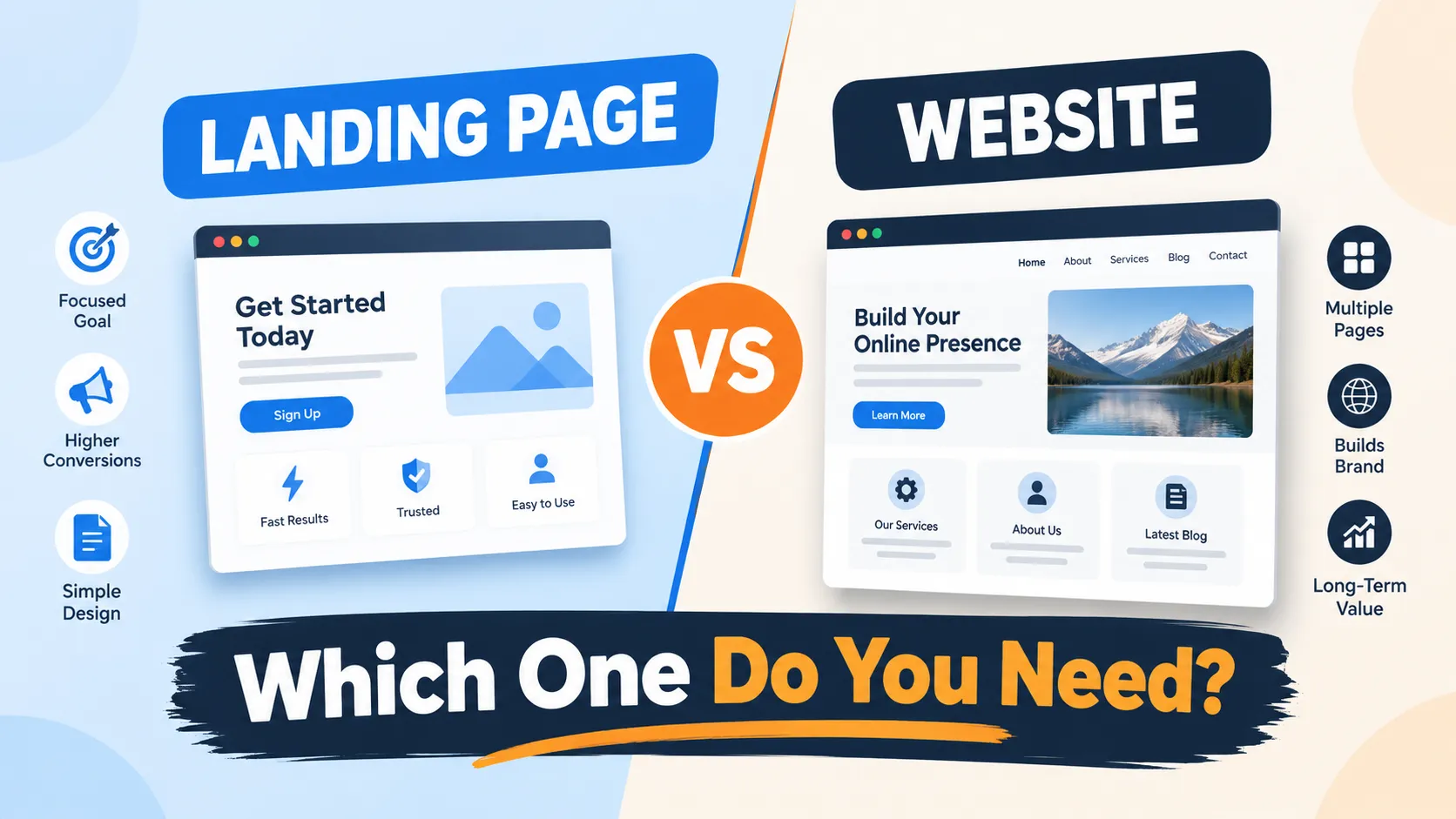
A landing page is a single focused page built to convert one type of visitor into one specific action, usually from paid ads or a campaign. A website is a multi-page asset built to be found in search, build credibility over time, and serve many different visitors at different stages. They solve different problems. Most growing businesses eventually need both, a website as the foundation and dedicated landing pages for each campaign.
What Is a Landing Page?
A landing page is one page with one offer, one message, and one call to action. It usually has no navigation menu at all, which is deliberate. Every extra link is another chance for someone to wander off before they act.
Its entire job is conversion. Someone clicks an ad, reads one focused argument, and either books, calls, or fills out a form. Nothing else competes for their attention.
A landing page is the right tool when:
- You’re running paid traffic from Google Ads, Meta, or similar platforms
- You’re promoting one specific offer, service, or seasonal promotion
- You want to test whether a service sells before investing further
- You need a clean read on cost per lead for a specific campaign
- You need something live quickly without building a full site
What Is a Website?
A website is a set of connected pages designed to be discovered organically, answer questions, and represent your business over years. It ranks in Google, supports your local search presence, and is what a serious prospect checks before signing anything meaningful.
Credibility is a real part of this. A business with no website looks temporary, especially to commercial clients and anyone comparing a few providers before deciding.
A website is the right tool when:
- You want organic search traffic that keeps arriving without ad spend
- You offer multiple services or serve multiple locations
- Your sales cycle involves research and comparison
- You want an asset you own, independent of any ad platform
- You’re building long-term authority in your market
Landing Page vs Website: Side by Side
Factor | Landing Page | Website |
Structure | One page, no navigation | Multiple connected pages |
Main goal | Convert one specific action | Inform, rank, and build trust |
Traffic source | Mostly paid ads and campaigns | Mostly organic search and direct |
Build time | Hours to a few days | Weeks, depending on scope |
SEO value | Limited by design | The main long-term SEO asset |
Lifespan | Campaign length | Years, with ongoing updates |
Best measured by | Conversion rate, cost per lead | Organic traffic, rankings, total leads |
What the Conversion Data Actually Shows
Here’s the part that makes this decision concrete. Unbounce’s Conversion Benchmark Report, based on 464 million visits across roughly 41,000 landing pages, found a median landing page conversion rate of 6.6% across industries, with top performing pages converting at 10% or higher. You can see the full benchmark breakdown here.
Now compare that to a typical homepage, which is built to serve every visitor at once rather than convert one specific intent. That’s the gap people are paying for when they route ad traffic to a homepage. The traffic isn’t the problem. The destination is.
The Most Expensive Mistake in This Decision
Sending paid traffic to your homepage. It happens constantly, and it quietly wastes a large share of most small ad budgets.
Someone clicks an ad for one specific service with one specific intent. They land on a page that introduces your whole company, lists every service you offer, and gives them a menu instead of an answer. The message they clicked on doesn’t match what they see. So they leave.
If you’re paying for clicks, the page they land on should match the ad closely enough that the visitor feels like they’re in the right place within two seconds. For most small advertisers, this is the single highest return fix available.
The Opposite Mistake
Relying only on landing pages and never building a real website. This creates a business that stops the moment ad spend stops. No organic traffic, no accumulated authority, no asset with lasting value.
It also weakens your local search presence. Search engines connect your business listing to your website, and a listing pointing to a single thin page carries far less supporting signal than one pointing to a site with real service pages and genuine content. In competitive local markets, that difference decides who shows up in the map results.
The Setup That Works for Most Businesses
For most small and mid-sized service businesses, the answer isn’t one or the other. It’s a small website plus dedicated landing pages for each campaign.
The website doesn’t need to be large. Five to eight pages is usually plenty:
- A homepage explaining what you do, for whom, and where
- One page per main service
- One page per primary location you serve, if location matters
- An About page with real photos and credentials
- Reviews or completed work
- A contact page with a short form and a clickable phone number
Then build a separate landing page for each ad campaign. The website earns traffic slowly and permanently. The landing pages convert paid traffic efficiently right now. If you’re weighing how to build that foundation, our comparison of a custom website vs a template covers that next decision in detail.
What Both Need to Get Right
Whichever you build, the same fundamentals decide whether it works:
- Speed. A slow page loses visitors before they see anything. Our guide on WordPress speed optimization covers the fixes that matter most.
- Mobile first. Most local service traffic is mobile. Clickable phone number near the top, short forms, large tap targets.
- Clarity in the first five seconds. What you do, where you do it, and what to do next.
- Real proof. Actual photos, reviews, credentials. Stock imagery reduces trust, especially for smaller providers.
- Tracking installed before you spend. Without conversion tracking, you’re optimizing blind.
It’s also worth running both through a basic usability check before launch. Our website usability checklist covers the specific things that quietly cost conversions.
How to Decide This Week
If you’re running ads right now and sending that traffic to your homepage, build a landing page first. That’s the fastest measurable improvement available to you.
If you have almost no digital presence and rely on referrals, build the small website first. It supports your search visibility, gives you credibility with bigger clients, and starts accumulating value immediately.
If you already have both, the work shifts from building to improving: faster load times, clearer offers, better proof, and one dedicated page per campaign.
How We Approach This at Zebuck
When a client asks us which one they need, the first thing we ask is where their traffic comes from today, not what they want to build. If they’re spending on ads without dedicated landing pages, we fix that first because it’s the quickest win. If they have no organic presence at all, we start with the website because that’s the asset that keeps working after the budget runs out. You can see examples of both in our portfolio.
If you’re not sure which one your budget should go toward next, talk to our team and we’ll give you a straight answer based on your actual traffic, not the bigger project. You can also explore our full web design and development services.
Frequently Asked Questions
Can a landing page rank in Google on its own?
It can, but it’s not built for it. Landing pages are designed for conversion, not discovery, and a single page without supporting content rarely builds the authority needed to rank for competitive terms. For organic search, a full website is the stronger investment.
Should I send Google Ads traffic to my homepage or a landing page?
A dedicated landing page, almost always. Homepages serve every visitor at once, while a landing page matches the specific ad the visitor clicked. That message match is one of the biggest factors in whether paid traffic converts or bounces.
How many landing pages should my business have?
One for each distinct offer or campaign you’re actively promoting. If you run three different ad campaigns for three different services, each should have its own page rather than sharing one generic page.
Is a landing page cheaper than a website?
Yes, usually significantly. A single focused page takes hours rather than weeks to build. That lower cost is exactly why landing pages work well for testing offers before committing to a larger build.
Can I use my website’s service page as a landing page?
Sometimes, but it’s a compromise. Service pages carry full navigation and serve multiple types of visitors, which pulls attention away from the one action you want. If a campaign is spending meaningful money, a dedicated page is worth the few hours it takes.
Do I still need a website if my landing page converts well?
Yes. A high-converting landing page depends entirely on paid traffic, so leads stop the moment spend stops. A website keeps earning organic visibility and credibility in the background, which is what makes growth sustainable rather than rented.

